The short answer
You obtain Dominica citizenship through the Dominica Citizenship by Investment Programme, either with a contribution of 200,000 USD to the Economic Diversification Fund (250,000 USD with up to three dependants) or with 200,000 USD in approved real estate plus a government fee of 75,000 USD. On top come 7,500 USD in due diligence, 1,000 USD processing, 1,000 USD per interview and 500 USD per certificate of naturalisation. You need no residence in Dominica, neither before nor after naturalisation, and as a German you keep your German passport.
Dominica is one of the five Caribbean states that grant citizenship in return for an investment, and it is the most affordable way in. How citizenship by investment works in general, and which programmes exist worldwide, is explained in Buying citizenship. The programme's key facts on a single page are under Dominica, and every open programme side by side is in the comparison.
Dominica citizenship: the programme at a glance
The programme's official name is the Dominica Citizenship by Investment Programme, and it has been running since 1993. Its legal basis is the Constitution, the Commonwealth of Dominica Citizenship Act and the Citizenship by Investment Regulations 2024, S.R.O. 8 of 2024, published in the Official Gazette on 28 June 2024 and amended by S.R.O. 46 of 2025. These regulations set out the amounts, the fees, the deadlines and the rules for real estate.
The responsible body is the Citizenship by Investment Unit in the Financial Center in Roseau. It receives the applications and communicates the decision. You cannot apply to the authority directly: every application goes through one of its licensed Authorised Agents.
Three things make Dominica the classic choice for many families:
- The price: 200,000 USD for a single applicant through the fund is the lowest entry point among the Caribbean programmes.
- No residence requirement: you need not live in Dominica, neither before nor after naturalisation, and you don't even have to travel to the island to apply.
- Family across three generations: spouses, children, parents and grandparents fit into one application, and the programme has been running for more than 30 years.
Buying citizenship in Dominica: fund or real estate
Dominica offers two routes, and both start at 200,000 USD. The difference: with the fund the money is spent, with real estate it stays with you as an asset.
| Route | Minimum amount | Family | Key feature |
|---|---|---|---|
| Economic Diversification Fund | 200,000 USD | single applicant | contribution, no return |
| Economic Diversification Fund | 250,000 USD | you and up to three dependants | each additional one 25,000 or 40,000 USD |
| Approved real estate | 200,000 USD | per main applicant | plus 75,000 USD government fee, hold for three years |
The Economic Diversification Fund
The simplest route: you pay a fixed contribution to the state, and the investment is done. For you alone it is 200,000 USD, with up to three dependants 250,000 USD. Each further dependant costs 25,000 USD if under 18 and 40,000 USD from 18. According to the authority, the money goes into education, health, sport and tourism on the island.
Two practical points: you cover bank charges on top, so that the full amount reaches the government. And if you pay in euros or pounds, you must transfer at least the equivalent in US dollars. The additional government fee of the real estate route does not apply to the fund.
Approved real estate
On the second route you buy a unit for at least 200,000 USD in a project the government has approved. On top comes a government fee of 75,000 USD for you alone or 100,000 USD with up to three dependants. Here too, each further dependant costs 25,000 USD under 18 and 40,000 USD from 18. Several applicants can invest together in one project, as long as each main applicant puts in the 200,000 USD.
The list of approved projects includes the InterContinental Dominica Cabrits Resort & Spa, The Residences at Secret Bay near Portsmouth, Jungle Bay Resort near Soufrière, Anichi Resort & Spa and Sanctuary Rainforest Eco Resort & Spa. You hold the property for at least three years from naturalisation. If you sell it to someone who uses it to apply for citizenship themselves, a holding period of five years applies.
The appeal: you own a unit in a Caribbean resort, which you can keep or sell after three years. If you are also weighing up buying property on the island outside the programme, the rules for foreigners are set out in Buying property in Dominica (in German). How the fund and real estate routes compare across all programmes is explained in Donation, real estate or government bonds.
What does the Dominica passport cost in 2026?
On top of the investment come the fees due with the application:
| Fee | Amount | Who pays |
|---|---|---|
| Due diligence fee | 7,500 USD | main applicant |
| Due diligence fee | 4,000 USD | each dependant aged 16 and over |
| Processing fee | 1,000 USD | per application |
| Interview fee | 1,000 USD | per interview |
| Certificate of naturalisation | 500 USD | per person |
For the most common cases, the sums look like this:
- You alone, fund: 200,000 USD contribution, 7,500 USD due diligence, 1,000 USD processing, 1,000 USD interview, 500 USD certificate, 210,000 USD altogether.
- You alone, real estate: 200,000 USD purchase price, 75,000 USD government fee, plus the same 10,000 USD in application fees, 285,000 USD altogether, of which 200,000 USD stays with you as property.
- Married couple with two children aged 10 and 17, fund: the 250,000 USD contribution covers all four. Due diligence is 7,500 USD for you and 4,000 USD each for your partner and the 17-year-old, so 15,500 USD. Processing 1,000 USD, four certificates 2,000 USD. That makes 268,500 USD, plus 1,000 USD per interview.
For nationals of certain countries, the regulations provide for a closer check, Enhanced Due Diligence. It has its own fees, which replace the standard due diligence and interview fees.
All in all, Dominica is the most affordable route to a Caribbean passport, and with a programme that has more than 30 years of history behind it. For all programmes compared by price, see Costs.
Who you can include in the application
Dominica is generous with family, across three generations:
- your spouse
- children under 18, yours and your spouse's, biological or adopted
- children aged 18 to 30 who attend a recognised university and whom you fully support
- unmarried daughters under 25 who live with you and whom you fully support
- children aged 18 and over with a physical or mental disability whom you fully support
- parents and grandparents, yours or your spouse's, over 65 whom you substantially support
And the family is allowed to grow: a minor child, biological or adopted, who joins after your naturalisation can be added later. Since S.R.O. 46 of 2025 there is no longer any time limit for this.
The grandparents make the difference: Dominica takes in not only your parents but also the generation above them. Which programmes naturalise parents and grandparents, and on what terms, is shown in Bringing parents and grandparents along. The family rules of every programme at a glance are under Family.
The process: from application to certificate of naturalisation
The road to the passport is clearly regulated, and the deadlines are written into the regulations.
Documents and application
As the main applicant you must be at least 18. For the application you need, among other things:
- a copy of your passport, valid for at least six months
- a certified birth certificate with an apostille or legalisation
- police clearance certificates from your country of birth, your country of residence and every country where you have lived for more than six months in the last ten years, no older than three months
- a medical certificate with blood test, urine test and HIV test, no older than three months
On the real estate route you first sign a binding purchase agreement, and the money sits in an irrevocable escrow account before the application is reviewed. On both routes you confirm in writing that you will not change your name in the first five years after naturalisation, except through marriage.
Due diligence and interview
The background check is commissioned by the Financial Intelligence Unit and covers every applicant aged 16 and over. Everyone aged 16 and over also has an interview, usually by video. Dominica must refuse, for example, in the case of criminal convictions beyond a minor offence, undisclosed investigations, a security risk or false statements in the application. With a clean record, you can go into the check calmly. What the state checks in detail is explained in Due diligence in the passport application.
Approval, payment, certificate
Within three months of submission, the authority must say whether the application is approved in principle, delayed for a stated reason, or refused. No later than 30 days after that approval, you prove that your contribution has reached the government or that the property is secured, and that all government fees are paid. The authority then issues the certificate of naturalisation, with which you apply for the passport. It is valid for up to ten years for adults and five years for children under 16, and you can renew it at any Dominica consulate.
The whole journey from the first conversation to the passport is laid out on the page How it works.
Travelling with a Dominica passport
A passport is worth as much as the doors it opens. With the Dominica passport, a close look pays off, because the picture differs by destination:
| Destination | With the Dominica passport | Source |
|---|---|---|
| Germany | visa-free, up to 90 days in any 180 | German Federal Foreign Office |
| United Kingdom | visa required | UK Immigration Rules |
| USA | visitor visas suspended since 1 January 2026 | US proclamation |
| OECS states | indefinite right to live and work | OECS |
Europe: the visa list of the German Federal Foreign Office (Auswärtiges Amt) shows Dominica as visa-exempt. With the national passport you may stay in Germany for up to 90 days in any 180-day period, as long as you do not work. How the EU views the Caribbean programmes, and how to protect yourself, is covered in EU visa suspension.
United Kingdom: Dominica is on the British list of visa national countries. You keep travelling to the UK on your German passport.
USA: the proclamation of 16 December 2025 has suspended, since 1 January 2026, immigrant visas and B-1 and B-2 visitor visas, among others, for nationals of Dominica. Dual nationals travelling on the passport of a country not affected are expressly exempt. So you fly to the USA on your German passport. In your ESTA application you declare every nationality truthfully. What that means in practice is explained in ESTA and a second citizenship.
The Caribbean itself: this is where the Dominica passport plays its real strength. Dominica is one of the seven Protocol Member States of the Organisation of Eastern Caribbean States, together with Antigua and Barbuda, Grenada, Montserrat, St Kitts and Nevis, St Lucia, and St Vincent and the Grenadines. As a citizen you may live indefinitely in any of these states and work without a work permit, spouse and dependants included. One passport opens up a whole chain of islands.
How the Dominica passport measures up against the other programme passports is shown in Travel freedom of CBI passports.
Dominica citizenship and your German passport
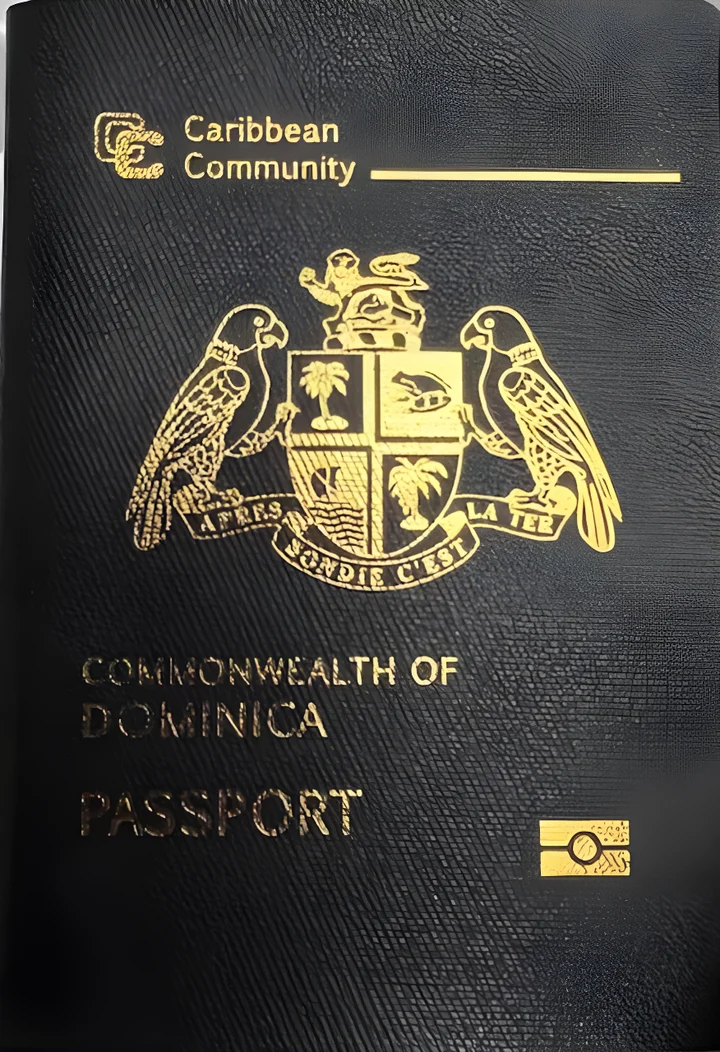
The most important question for Germans has a quick answer: you keep your German passport. Since 27 June 2024, acquiring a foreign nationality by application no longer leads to the loss of German citizenship. The former section 25 of the Nationality Act (Staatsangehörigkeitsgesetz, StAG), which provided exactly that, has been repealed. Dominica too recognises dual citizenship and does not require you to give up other passports.
That makes the Dominica passport what it is meant to be: a second nationality alongside your German one. And that is a world of difference. A state can refuse or revoke a visa, but citizenship is a right you can rely on for life. According to the authority, it is valid for life and can be passed on to future generations.
On tax, Dominica is relaxed. The island levies no wealth tax, no gift or inheritance tax, no tax on foreign income and no capital gains tax. You pay income tax there only if you live on the island. Whether you remain taxable in Germany depends on your residence and habitual abode, not on your passport. For details, see Taxes. If you are also looking at Dominica as a tax base, the country profile is at Taxes in Dominica (in German).
Who the Dominica passport is right for
Dominica suits you if you want a solid second passport at the lowest Caribbean price, without turning your life upside down. Three situations are typical:
You want a safety net, not a move. Then the fund is the clearest route: pay once, no management, no holding period, no residence requirement. The passport sits in the drawer and waits for the day you need it.
You think in terms of family. Spouse, children up to 30 at university, and parents and grandparents over 65 fit into one application. For a family of up to four, the contribution stays at 250,000 USD.
You want the Caribbean as an option. The passport opens up living and working in seven Eastern Caribbean states. What life on Dominica feels like compared with St Lucia is described in Emigrating to Dominica or St Lucia (in German).
And one last thought: citizenship by investment and naturalisation are not mutually exclusive. Naturalisation through genuine residence is the free route and often the better one in the end, but it takes years. The Dominica passport buys you exactly that time. How the two routes work together is shown in CBI and naturalisation.
Frequently asked questions
Can you buy Dominica citizenship?
Yes. The Dominica Citizenship by Investment Programme has granted citizenship in return for an investment since 1993, today 200,000 USD in the Economic Diversification Fund or in government-approved real estate. The legal basis is the Citizenship by Investment Regulations 2024, S.R.O. 8 of 2024. How such programmes work in general is explained in Buying citizenship.
What does the Dominica passport cost in total?
Through the fund alone you pay a 200,000 USD contribution, 7,500 USD in due diligence, 1,000 USD processing, 1,000 USD for the interview and 500 USD for the certificate, 210,000 USD in government charges altogether. Through approved real estate it is a 200,000 USD purchase price plus a 75,000 USD government fee and the same application fees. For every programme by price, see Costs.
Do I have to live in Dominica or travel there?
No. The Citizenship by Investment Unit makes clear that you need not live in Dominica, neither before nor after naturalisation. The application itself needs no trip either, and the interview usually takes place by video. A visit to the island is welcome, but not required.
Can I keep my German passport?
Yes. Since 27 June 2024 you no longer lose German citizenship when you acquire a foreign one by application, because the former section 25 of the Nationality Act (StAG) has been repealed. Dominica also recognises dual citizenship and does not ask you to give up the passports you already hold.
How long does the Dominica application take?
The regulations require the authority to respond within three months of submission: approved in principle, delayed for a stated reason, or refused. After that approval you have no more than 30 days to prove your investment and fees, and the certificate of naturalisation follows. How Dominica compares on speed is shown in How soon will your second passport be in your hand?.
Can I travel to the USA with a Dominica passport?
Since 1 January 2026 the US government has suspended visitor visas, among others, for nationals of Dominica. Dual nationals travelling on the passport of a country not affected are exempt. So you travel to the USA on your German passport and declare every nationality truthfully in your ESTA application.
How long do I have to hold the property in Dominica?
At least three years from naturalisation; only then may you sell it on. If you sell to someone who wants to use it to apply for citizenship themselves, the property must have been held for at least five years. For the investment types side by side, see Donation, real estate or government bonds.
Is Dominica right for you and your family?
Together we run the numbers on the fund and real estate routes for your family and check whether Dominica or another programme does more for you. That way you decide with clear figures before you pay the first fee.
Book a consultationSources
- Citizenship by Investment Unit Dominica: home page
- Citizenship by Investment Unit Dominica: FAQs
- Commonwealth of Dominica: Citizenship by Investment Regulations 2024, S.R.O. 8 of 2024
- Citizenship by Investment Unit Dominica: Economic Diversification Fund
- Citizenship by Investment Unit Dominica: Approved Real Estate Projects
- Citizenship by Investment Unit Dominica: How to Apply
- German Federal Foreign Office (Auswärtiges Amt): visa requirements by country
- GOV.UK: Immigration Rules Appendix Visitor: Visa national list
- The White House: Proclamation Restricting and Limiting the Entry of Foreign Nationals, 16 December 2025
- OECS: Free Movement of Persons in the Eastern Caribbean
- Gesetze im Internet: Nationality Act (Staatsangehörigkeitsgesetz), section 25 (repealed)
- Commonwealth of Dominica: Citizenship by Investment (Amendment) Regulations 2025, S.R.O. 46 of 2025